
Texas Shareholder Disputes: Minority Rights and Remedies in Closely Held Businesses

You own a piece of the company — but the majority owners control the board, the bank account, and the books. When communication breaks down or those in control abuse their power, minority owners in Texas closely held businesses often discover an uncomfortable truth: unlike some states that offer broad common-law protections for “shareholder oppression,” Texas requires minority owners to rely on strict statutory frameworks and breach of fiduciary duty claims to protect their investments.
Whether you hold an interest in a Texas corporation, limited liability company (LLC), or partnership, understanding your rights under the Texas Business Organizations Code (TBOC) is critical to protecting your financial interests.
The Reality of Shareholder Disputes in Texas
A closely held corporation is defined under Texas law as a corporation with fewer than 35 shareholders and no shares listed on a national securities exchange or regularly quoted over-the-counter [1]. Because these shares lack a public market, a minority shareholder cannot simply sell their stock and walk away when disputes arise. This dynamic can leave minority owners vulnerable to “freeze-out” or “squeeze-out” tactics by majority owners who control the board of directors and the company’s daily operations.
Historically, some Texas courts recognized a common-law claim for “shareholder oppression,” which allowed minority shareholders to sue majority owners for unfair treatment and sometimes force a buyout of their shares. However, in the landmark 2014 decision Ritchie v. Rupe, the Texas Supreme Court fundamentally changed the landscape [2]. The Court refused to recognize a common-law cause of action for shareholder oppression and clarified that it has never recognized a formal fiduciary duty owed directly by majority shareholders to minority shareholders in a closely held corporation [2].
As a result, minority owners must look to specific statutory remedies and derivative actions to seek justice when majority owners mismanage the company or abuse their power. These disputes often arise in entities that were formed without comprehensive governance documents; our overview of forming an LLC in Texas for asset protection explains how entity structure affects owner rights from the outset.
Statutory Remedies for Minority Owners
While Ritchie v. Rupe eliminated the common-law oppression claim, the Texas Business Organizations Code still provides powerful tools for minority owners facing severe mismanagement or illegal conduct.
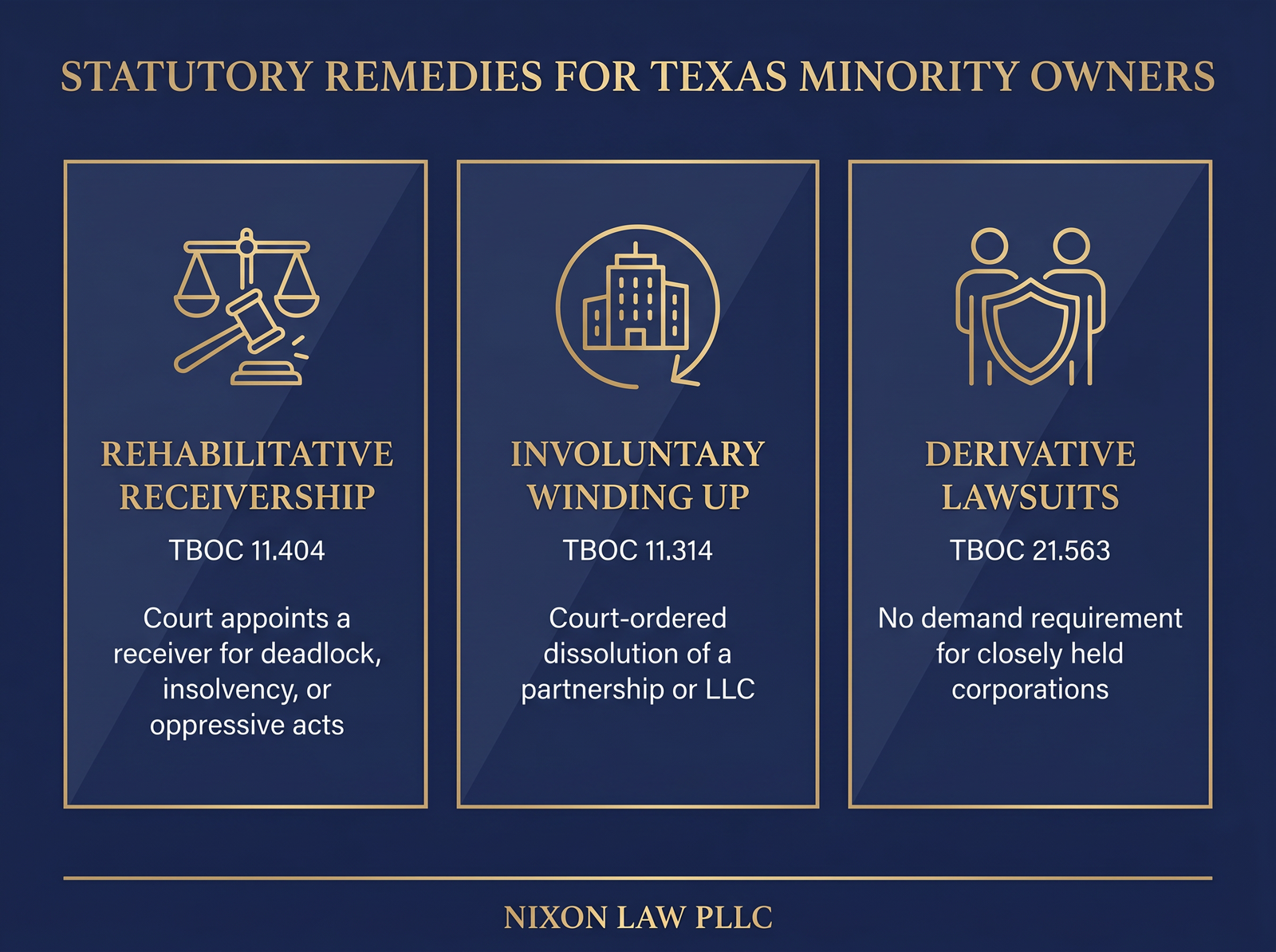
1. Rehabilitative Receivership (TBOC § 11.404)
Under Section 11.404 of the TBOC, a court may appoint a receiver to rehabilitate a domestic entity [3]. This is a drastic remedy where a court-appointed official takes control of the business to conserve its property and avoid damage to interested parties.
A minority owner can petition for a receiver if they can establish that:
- The entity is insolvent or in imminent danger of insolvency;
- The governing persons are deadlocked, causing or threatening irreparable injury;
- The actions of the governing persons are illegal, oppressive, or fraudulent;
- The property of the entity is being misapplied or wasted; or
- The shareholders are deadlocked in voting power and have failed to elect successors for at least two years [3].
However, the appointment of a receiver is considered a remedy of last resort. A court will only grant this relief if it determines that all other available legal and equitable remedies are inadequate [3]. Furthermore, the Texas Supreme Court has made clear that the appointment of a rehabilitative receiver is the only remedy available for “oppressive” actions under this statute—a minority shareholder cannot use this statute to force the majority to buy out their shares [2]. If the conditions necessitating the receiver are remedied, the receivership is terminated and management is restored to the company’s officials [3].
2. Involuntary Winding Up and Termination (TBOC § 11.314)
For owners of a Texas partnership or LLC, Section 11.314 provides a mechanism to force the dissolution of the business [4]. A district court may order the winding up and termination of the entity upon application by an owner if the court determines that:
- The economic purpose of the entity is likely to be unreasonably frustrated;
- Another owner has engaged in conduct relating to the entity’s business that makes it not reasonably practicable to carry on the business with that owner; or
- It is not reasonably practicable to carry on the entity’s business in conformity with its governing documents [4].
This statutory remedy provides a vital exit strategy when a partnership or LLC becomes irreparably dysfunctional due to the conduct of a co-owner.
Derivative Lawsuits in Closely Held Corporations
When corporate officers or directors mismanage funds, engage in self-dealing, or breach their fiduciary duties, the harm is technically suffered by the corporation itself, not the individual shareholders. To address this, shareholders can file a “derivative lawsuit” on behalf of the corporation against the wrongdoers.
In traditional corporations, filing a derivative suit requires the shareholder to first make a formal demand on the board of directors to take action, a process that can be easily thwarted by the very directors accused of wrongdoing. However, Texas law provides a significant advantage for shareholders of closely held corporations.
Under TBOC § 21.563, the standard demand requirements do not apply to derivative proceedings brought by a shareholder of a closely held corporation against a director, officer, or shareholder [1]. In 2015, the Texas Supreme Court affirmed this principle in Sneed v. Webre, holding that shareholders of closely held corporations can pursue derivative claims without board interference [5]. The Court also ruled that “double-derivative” suits are permitted, allowing a shareholder of a parent company to bring a derivative claim on behalf of a wholly owned subsidiary [5].
Furthermore, if justice requires, a court may treat a derivative proceeding in a closely held corporation as a direct action brought by the shareholder for their own benefit, and any recovery may be paid directly to the plaintiff rather than the corporation [1]. These claims frequently overlap with other business conflicts; for example, our discussion of civil litigation strategy in Texas illustrates how courts weigh competing interests in contested matters.
The Importance of Proactive Legal Agreements

Because Texas law does not automatically impose fiduciary duties between co-shareholders, and because statutory remedies like receivership are difficult to obtain, the most effective way to protect minority rights is through well-drafted corporate documents.
Shareholder agreements, company agreements (for LLCs), and buy-sell agreements can establish clear rules for governance, dispute resolution, and buyout procedures. These contracts can create the fiduciary duties and buyout rights that Texas common law does not provide by default. Owners planning ahead should review our guidance on forming a business entity in Texas to build these protections into the company from day one.
Frequently Asked Questions About Texas Shareholder Disputes
Can a minority shareholder in Texas force the majority to buy out their shares?
Generally, no. After Ritchie v. Rupe, Texas does not recognize a common-law shareholder oppression claim, and the Texas Supreme Court held that a court-ordered buyout is not an available remedy under the receivership statute [2]. A buyout right typically must come from a contract, such as a shareholder or buy-sell agreement.
Do majority shareholders owe a fiduciary duty to minority shareholders in Texas?
The Texas Supreme Court has stated that it has not recognized a formal fiduciary duty owed directly by majority shareholders to minority shareholders in a closely held corporation [2]. Fiduciary duties more commonly arise between officers or directors and the corporation, or by contract.
What is a derivative lawsuit, and is it easier for closely held corporations?
A derivative lawsuit is a claim a shareholder brings on behalf of the corporation for harm done to the company. Under TBOC § 21.563, shareholders of closely held corporations are not subject to the usual demand-on-the-board requirement, which the Texas Supreme Court confirmed in Sneed v. Webre [1][5].
Protecting Your Business Interests in Texas
Shareholder and partnership disputes are legally complex and highly contentious. If you are a minority owner facing unfair treatment, or a majority owner defending against allegations of mismanagement, you need experienced legal counsel to navigate the strict statutory requirements of the Texas Business Organizations Code.
At Nixon Law PLLC, our commercial litigation team has deep experience handling complex business disputes, derivative actions, and entity dissolutions. We provide authoritative, strategic representation to protect your financial interests and your business.
Contact Nixon Law PLLC today at 713-482-1523 or visit www.nixon-law.com to schedule a consultation regarding your shareholder or partnership dispute.
This article is provided for general informational purposes only and does not constitute legal advice. Reading this article does not create an attorney-client relationship. Every situation is unique; you should consult a licensed Texas attorney about your specific circumstances.
References
- [1] Tex. Bus. Orgs. Code § 21.563.
- [2] Ritchie v. Rupe, 443 S.W.3d 856 (Tex. 2014).
- [3] Tex. Bus. Orgs. Code § 11.404.
- [4] Tex. Bus. Orgs. Code § 11.314.
- [5] Sneed v. Webre, 465 S.W.3d 169 (Tex. 2015).
Have a related legal question? Nixon Law PLLC offers a free consultation.